Tell us about the job
Takes about a minute. No obligation.
The reversing valve cycles every time a heat pump switches between heating and cooling modes, and in this county it switches a great deal. Homes in Washington County, RI run heat about eight months a year, from October through May. By late spring, the valve and the refrigerant circuit have absorbed the bulk of what the season demanded, and a contractor diagnosing a fault here opens with those components rather than the electrical side. Worn valve seats and low refrigerant charge both trace back to accumulated heating-mode runtime, not to a single event.
Half the homes in Washington County, Rhode Island were built in 1977 or earlier (2020-2024 ACS 5-year). A house that old has run heat through the same coils and capacitors long enough that what a contractor finds when the unit is opened tends to decide the job. Refrigerant circuits degrade, capacitors drift out of tolerance, contactors pit. Whether the parts a system like this takes are still in production is a real question on a repair call here, not a theoretical one. The age of the housing is the reason the opened equipment deserves the closer look.
The Parts of a Heat Pump a Contractor Checks First
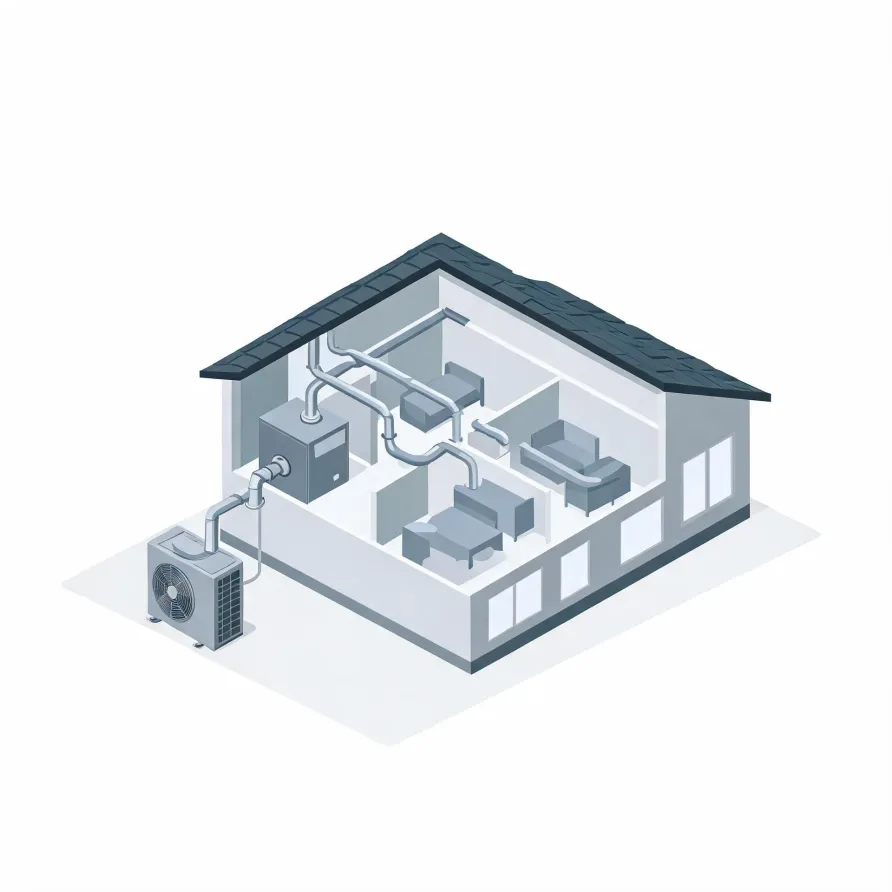
The outdoor unit is usually where a contractor starts. It holds the compressor, which drives the whole system, and the coil that absorbs or releases heat depending on the season. A failed compressor, a refrigerant leak at the coil, or a seized fan motor in that cabinet will stop the system from conditioning the house at all.
Inside the house, the air handler moves air across an indoor coil and pushes it through the home. The reversing valve, which sits in the refrigerant line and tells the system which direction to run, is a frequent repair point when a heat pump heats in one mode but not the other. The expansion device and the electrical controls that tie both units together round out what a contractor works through.
The drawing shows the general layout of a heat pump system, and a licensed contractor determines which components apply and what work is needed in your specific home.
Find a contractor in Washington CountyWashington County by the Numbers
166 severe weather events were recorded in Washington County, Rhode Island between 2015 and 2024.
NOAA National Centers for Environmental Information, Storm Events Database, bulk CSV export, events 2015-01-01 through 2024-12-31.Half the homes in Washington County, Rhode Island were built in 1977 or earlier (2020-2024 ACS 5-year).
U.S. Census Bureau, 2020-2024 American Community Survey 5-Year EstimatesWashington County, Rhode Island holds 66,385 housing units (2020-2024 ACS 5-year).
U.S. Census Bureau, 2020-2024 American Community Survey 5-Year EstimatesOwners occupy 77.5% of the occupied homes in Washington County, Rhode Island (2020-2024 ACS 5-year).
U.S. Census Bureau, 2020-2024 American Community Survey 5-Year EstimatesCodes & Standards Governing Heat Pump Repair in Washington County, Rhode Island2 sourced rules & standards
Contractor Rules in Washington County, Rhode Island
A Rhode Island master licensee needs no separate sheet metal licence while the air handling equipment is ten (10) tons or less, or the heating equipment does not exceed 250,000 BTUs; above either figure the sheet metal work must be subcontracted to a licensed sheet metal contractor.
Rhode Island requires a licence from the Department of Labor and Training to work in the mechanical trades: nobody may hold themselves out as a master, or advertise that they will install refrigeration and air conditioning or air distribution systems, without one.
Severe Weather Events in Washington County
Weather puts real load on heat pump systems, and that load accumulates differently depending on where the equipment sits. Repair patterns in Washington County reflect what the climate has asked of the hardware over time.
166 severe weather events, 2015–2024. Source: NOAA National Centers for Environmental Information, Storm Events Database.