Tell us about the job
Takes about a minute. No obligation.
A heat pump here earns most of its wear on the heating side. Homes in Kent County, RI run heat about eight months a year, from October through May. Cold outdoor air forces the refrigerant circuit to work harder to extract heat, and the defrost cycle runs repeatedly across those months. By the time a homeowner calls for a repair, the compressor, the reversing valve, and the defrost board have each been through a full seasonal load. A contractor diagnosing the fault looks at those components first, because they carry the bulk of the runtime hours before anything else shows strain.
Refrigerant lines and control wiring in a house this old have frequently been rerouted or spliced to accommodate a replacement unit that arrived well after the original system did. Half the homes in Kent County, Rhode Island were built in 1967 or earlier (2020-2024 ACS 5-year). That gap between when the house was built and when its current equipment went in is where repair work gets complicated: what a contractor finds once the unit is open can include connections and wiring runs that belong to two or three different generations of equipment. A frayed splice or a mismatched line set from a prior retrofit can produce symptoms that look like a failing compressor until the cabinet comes off.
The Parts of a Heat Pump a Contractor Checks First
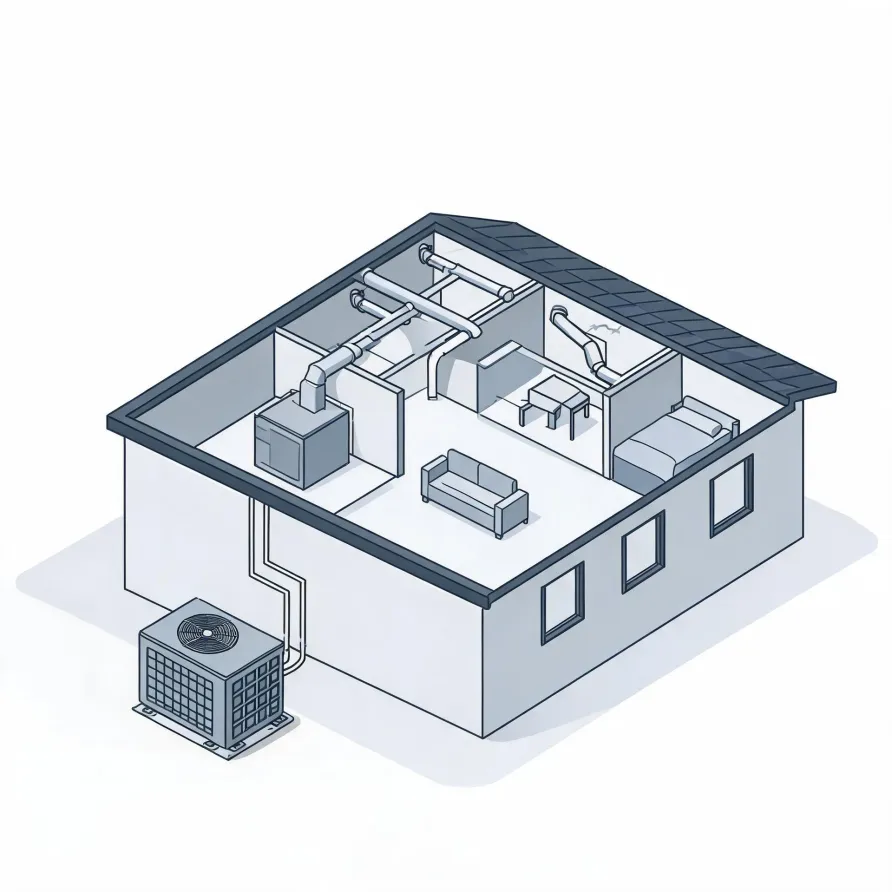
The outdoor unit is the piece most homeowners recognize, and it sits on a pad or wall bracket outside the house. Inside the metal cabinet are the compressor, the condenser coil, and the fan. When a heat pump stops heating or cooling properly, the compressor and the coil are the first places a contractor looks.
Inside the house, the air handler holds the evaporator coil and the blower fan, and it pushes conditioned air through the home. The refrigerant lines run between the two units, and the reversing valve inside the system is what lets a heat pump work in both directions. A fault in the reversing valve or a refrigerant leak in the lines can mimic the symptoms of a failed coil or compressor, so a contractor traces the problem through each of these pieces before drawing a conclusion.
The drawing shows the general layout of a heat pump system, and a licensed contractor determines which components apply and what work is needed in your specific home.
Find a contractor in Kent CountyKent County, Rhode Island, by the numbers
146 severe weather events were recorded in Kent County, Rhode Island between 2015 and 2024.
NOAA National Centers for Environmental Information, Storm Events Database, bulk CSV export, events 2015-01-01 through 2024-12-31.Half the homes in Kent County, Rhode Island were built in 1967 or earlier (2020-2024 ACS 5-year).
U.S. Census Bureau, 2020-2024 American Community Survey 5-Year EstimatesKent County, Rhode Island holds 76,529 housing units (2020-2024 ACS 5-year).
U.S. Census Bureau, 2020-2024 American Community Survey 5-Year EstimatesOwners occupy 73.1% of the occupied homes in Kent County, Rhode Island (2020-2024 ACS 5-year).
U.S. Census Bureau, 2020-2024 American Community Survey 5-Year EstimatesCodes & Standards Behind Heat Pump Repair in Kent County, Rhode Island2 sourced rules & standards
Licensing and Legal Requirements in Kent County, Rhode Island
A Rhode Island master licensee needs no separate sheet metal licence while the air handling equipment is ten (10) tons or less, or the heating equipment does not exceed 250,000 BTUs; above either figure the sheet metal work must be subcontracted to a licensed sheet metal contractor.
Rhode Island requires a licence from the Department of Labor and Training to work in the mechanical trades: nobody may hold themselves out as a master, or advertise that they will install refrigeration and air conditioning or air distribution systems, without one.
Severe Weather Events in Kent County
Extreme weather puts heat pumps under the kind of stress that accelerates wear and surfaces faults. How much of that stress a system carries depends on where it operates, which makes local conditions a real factor in repair frequency.
146 severe weather events, 2015–2024. Source: NOAA National Centers for Environmental Information, Storm Events Database.