Tell us about the job
Takes about a minute. No obligation.
A contractor diagnosing a heat pump in Providence County starts with the compressor and reversing valve, because those parts carry the full load of the heating season here. Homes in Providence County, RI run heat about eight months a year, from October through May. Capacity on a heat pump drops as outdoor temperatures fall, so the compressor works hardest during the coldest stretches of that run, cycling repeatedly under load. Wear on the reversing valve follows the same pattern. By the time a homeowner calls for repair, a contractor expects to find those components showing cumulative stress rather than a single event.
Ductwork laid down for an oil furnace or a boiler does not behave the same way once a heat pump is running through it, and in Providence County that gap between original design and current equipment is where most repair diagnoses go long. Half the homes in Providence County, Rhode Island were built in 1956 or earlier (2020-2024 ACS 5-year). A system that has been adapted across multiple equipment generations can carry wear in places that the unit's own age does not predict: a refrigerant line chafing against a joist run decades before the heat pump arrived, a splice made during a retrofit that now reads as intermittent fault. The contractor opening the unit is also, in effect, opening the history of what the house has asked of it since.
The Parts of a Heat Pump a Contractor Checks First
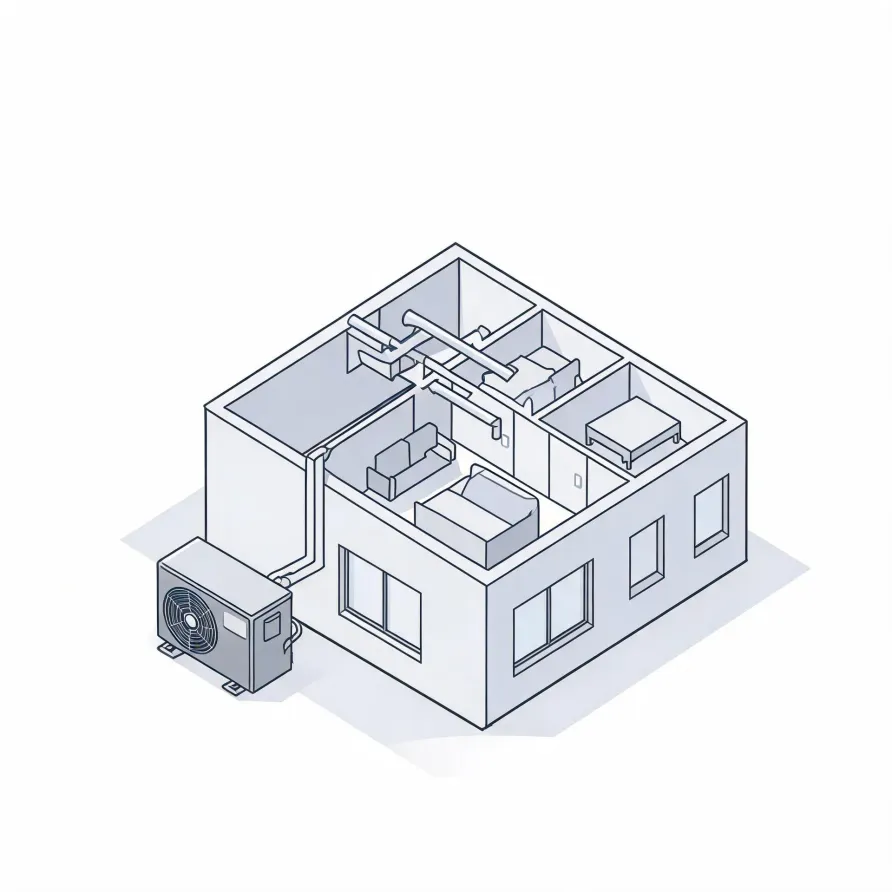
The outdoor unit sits outside the house and holds the compressor and condenser coil. These are the parts a contractor goes to first when a heat pump stops heating or cooling properly. A failed compressor, a refrigerant leak at the coil, or a seized fan motor in that cabinet will each kill the system in a different way.
Inside, the air handler holds the evaporator coil and the blower that moves air through the house. A clogged coil, a burned blower motor, or a dirty filter slot can all point to the air handler as the source of the problem. The refrigerant lines that run between the two units and the reversing valve that switches the system between heating and cooling modes are also on a contractor's checklist.
The drawing shows a typical layout, and a licensed contractor determines which components apply to your specific system and situation.
Find a contractor in Providence CountyProvidence County, by the numbers
236 severe weather events were recorded in Providence County, Rhode Island between 2015 and 2024.
NOAA National Centers for Environmental Information, Storm Events Database, bulk CSV export, events 2015-01-01 through 2024-12-31.Half the homes in Providence County, Rhode Island were built in 1956 or earlier (2020-2024 ACS 5-year).
U.S. Census Bureau, 2020-2024 American Community Survey 5-Year EstimatesProvidence County, Rhode Island holds 277,740 housing units (2020-2024 ACS 5-year).
U.S. Census Bureau, 2020-2024 American Community Survey 5-Year EstimatesOwners occupy 56.9% of the occupied homes in Providence County, Rhode Island (2020-2024 ACS 5-year).
U.S. Census Bureau, 2020-2024 American Community Survey 5-Year EstimatesCodes & Standards for Heat Pump Repair in Providence County, Rhode Island2 sourced rules & standards
Licensing Rules for HVAC Repair in Providence County, Rhode Island
A Rhode Island master licensee needs no separate sheet metal licence while the air handling equipment is ten (10) tons or less, or the heating equipment does not exceed 250,000 BTUs; above either figure the sheet metal work must be subcontracted to a licensed sheet metal contractor.
Rhode Island requires a licence from the Department of Labor and Training to work in the mechanical trades: nobody may hold themselves out as a master, or advertise that they will install refrigeration and air conditioning or air distribution systems, without one.
Severe Weather Events in Providence County
Extreme weather puts heat pumps under stress, and how hard a system works over time shapes when and why it needs repair. Providence County's weather record is part of what determines the service demands local equipment faces.
236 severe weather events, 2015–2024. Source: NOAA National Centers for Environmental Information, Storm Events Database.